
.png)
.jpg)
Reading a research paper can feel like walking into a room where everyone already knows the vocabulary, the background debate, and the hidden logic behind each citation.
You may understand individual sentences, but still struggle to answer simple questions like: What is the paper really arguing? How are the concepts connected? Which part matters for my literature review? And where should I look next?
That is where a literature map can help.
Instead of treating a research paper as one long block of text, a literature map turns it into a visual structure. You can see the main topic, supporting ideas, methods, findings, limitations, and follow-up questions in one place. For students and researchers, this makes academic reading easier to understand, organize, and reuse.
In this guide, I will walk through how to turn a research paper into a literature map with Mapify, then show how to edit, expand, question, and deepen that map for real research work.
What Is a Literature Map?
A literature map is a visual way to organize academic information.
For a single research paper, it can show the paper's main argument, research question, theoretical background, methodology, findings, limitations, and implications. For a broader topic, it can also connect multiple papers, compare themes, and reveal possible research gaps.
A plain summary tells you what a paper says. A literature map helps you see how the ideas are connected.
That difference matters. When you are preparing a literature review, thesis proposal, class presentation, or research discussion, you usually do not just need a shorter version of the paper. You need a structure you can think with.
Why Turn a Research Paper into a Literature Map?
Research papers are dense because they are doing several things at once. They explain background, position themselves in an existing field, describe methods, present evidence, discuss findings, and point toward future research.
A literature map helps you separate those layers.
It can help you:
- understand the paper's logic before getting lost in details
- identify the main argument and supporting evidence
- compare methods, findings, and limitations more easily
- organize notes for a literature review
- find concepts or gaps worth exploring further
This is especially useful when a paper introduces unfamiliar theories, technical methods, or a long chain of related studies. Instead of repeatedly scrolling through the PDF, you can work from a visual map and return to the original paper when you need detail.
Instantly turn your content into mind maps with AI
Get Started NowStep 1: Upload or Import Your Research Paper into Mapify
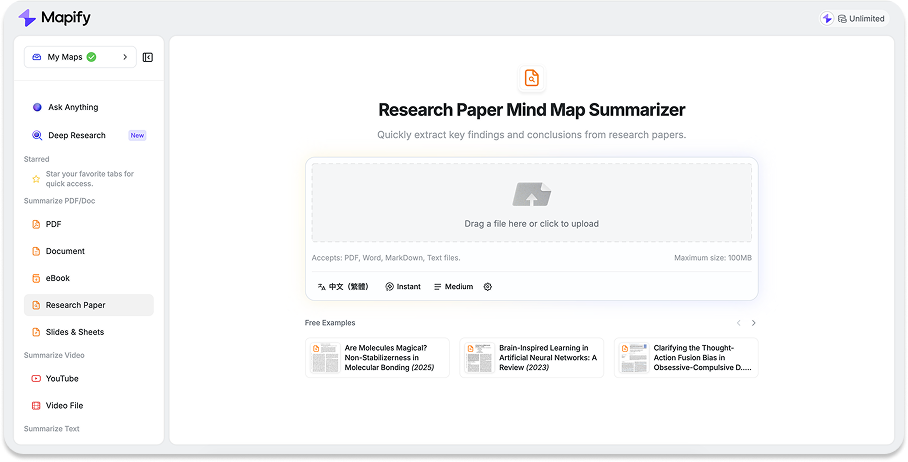
Start by uploading your research paper or PDF into Mapify.
Mapify can turn a complex paper into a structured visual mind map, giving you a first version of the paper's key ideas. Instead of beginning with a blank note page, you get an organized structure that highlights the main topic, important sections, and supporting details.
This first map does not need to be perfect. Think of it as a reading scaffold. It gives you a way to enter the paper without feeling like you have to understand everything at once.
For a student, that might mean quickly seeing what the paper is about before a seminar. For a researcher, it might mean identifying which parts are useful for a literature review, thesis chapter, or research proposal.
Step 2: Review the Main Branches Before Editing
Once the map is generated, do not rush to change it immediately.
First, scan the top-level branches. In an academic paper, these often include areas like:
- research question
- background
- theoretical framework
- methodology
- findings
- limitations
- implications
This step gives you a high-level view of the paper. You can quickly see whether the paper is mainly theoretical, empirical, methodological, or review-based.
It also helps you decide what to read more carefully. If you are preparing for a class discussion, you may focus on the findings and implications. If you are writing a literature review, you may pay closer attention to the background, methods, limitations, and gaps.
Step 3: Edit the Literature Map for Your Own Research Goal
The most useful literature map is not always the one that follows the paper exactly. It is the one that matches your task.
In Mapify, you can keep editing the mind map after it is generated. You can add branches, delete unnecessary details, move branches around, and reorganize the structure. You can also use rich text to highlight key ideas, mark important findings, or separate your own notes from the paper's original content.
For example, if you are using the paper for a literature review, you might create branches like:
- concepts to define
- studies to compare
- methods to mention
- limitations to cite
- possible research gaps
If you are preparing a presentation, you might simplify the map around the paper's problem, approach, evidence, and takeaway.
This is where the map becomes more than an AI summary. It becomes your working structure.
Step 4: Expand a Specific Topic into the Next Layer
Sometimes one branch of the map will raise a new question.
Maybe the paper mentions a theory you have not studied before. Maybe the methodology is unfamiliar. Maybe there is a concept that seems important but is only briefly explained. Or maybe one limitation points to a possible research gap.
In Mapify, you can right-click a topic and expand it into the next layer. This lets you build more detail around a specific idea without losing the larger structure of the paper.
Good topics to expand include:
- a theory mentioned in the literature review
- an unfamiliar research method
- a key variable or concept
- a debate between different studies
- a possible research gap
This is useful because research rarely moves in a straight line. You start with one paper, then one branch leads to another question, and that question leads to a deeper topic. A good literature map should support that kind of exploration.
Step 5: Ask AI When the Original Paper Is Confusing
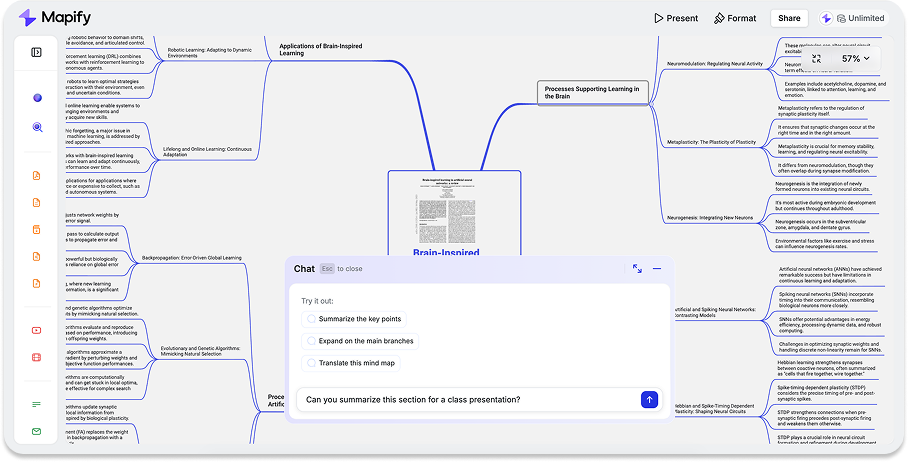
Even with a visual map, some parts of a research paper can still be hard to understand.
When that happens, you can use the chatbotto ask follow-up questions about the paper. Instead of leaving your reading workflow to search elsewhere, you can ask questions directly while looking at the map.
For example, you might ask:
- "Can you explain this method in simpler words?"
- "How does this finding connect to the research question?"
- "What should I focus on if I am writing a literature review?"
- "Can you summarize this section for a class presentation?"
This is helpful when you understand the general structure but need clarification on a specific section. It also makes the map feel more interactive. You are not just reading a static output; you are working through the paper with a tool that can help you question and refine your understanding.
Step 6: Use Deep Research for Topics That Need More Sources
One paper is often only the beginning.
If a concept, method, or research gap deserves deeper exploration, you may need more than the original paper. This is where Mapify's Deep Research can help.
Deep Research is useful when you want to move from understanding one paper to exploring a broader topic. It can help plan a research direction, search across sources, cross-check information, and generate a source-backed report together with an editable mind map.
This is especially valuable for:
- literature reviews
- thesis topic exploration
- research background sections
- comparing different studies
- building a stronger understanding of a new field
For example, a paper might briefly mention "AI feedback in education" as a future research direction. You can start with that branch in your map, then use Deep Research to explore the topic across multiple sources and generate a more complete research view.
What You Can Do After Turning a Paper into a Literature Map
Once you have a literature map, the next step depends on what you are trying to accomplish. Here are three common workflows.
From One Paper to a Literature Review Outline
If you are working on a literature review, the map can become your first outline.
Keep the branches that help you write: theory, methodology, findings, limitations, future research, and related studies. Then add your own notes, such as "use this for background section," "compare with Paper B," or "possible gap for proposal."
This turns reading into writing preparation. You are no longer just collecting highlights. You are building a structure you can reuse when drafting your review.
From Multiple Papers to One Map
If you already have several papers, class readings, or research notes, you may want to organize them into one view.
Mapify's Ask Anything is useful here because it supports working with multiple files. You can upload several papers, ask cross-file questions, compare sources, and turn the result into an editable mind map.
You might ask:
- "What are the common findings across these papers?"
- "Which papers use similar methods?"
- "What are the main disagreements between these studies?"
- "Can you organize these papers by theme?"
This is a practical workflow for literature reviews, reading groups, course essays, and thesis proposals. Instead of keeping each paper in a separate PDF, you can start building a connected view of the topic.
From One Paper to a Topic You Want to Explore Deeper
Sometimes a single paper gives you a topic you want to understand more seriously.
It might be a theory, a method, a surprising finding, or a research gap. You can first expand that branch inside the map. If the topic needs broader evidence, you can move into Deep Research and generate a source-backed map and report.
This workflow is useful when you go from "I understand this paper" to "I want to research this topic."
Common Mistakes When Making a Literature Map from a Paper
A literature map is only useful if it supports your thinking. Here are a few mistakes to avoid.
The first mistake is copying the paper's structure without adapting it. A paper is written for publication, but your map should serve your task. Do not be afraid to reorganize branches around your literature review, presentation, or research question.
The second mistake is treating the AI-generated map as the final answer. The first version is a starting point. Editing, deleting, moving, and highlighting are what make it useful for your own work.
The third mistake is ignoring methods and limitations. Students often focus only on findings, but methods and limitations are where many literature review insights come from.
The fourth mistake is relying on one paper when the topic clearly needs broader comparison. If you are making claims about a field, a debate, or a research gap, use multiple sources and check how they relate to each other.
Quick Notes Before You Start
Is a literature map the same as a mind map?
Not exactly. A mind map is a general visual format. A literature map is focused on academic relationships, such as research questions, theories, methods, findings, limitations, and gaps. In Mapify, you can use the mind map format to build a literature map from a paper.
Can I use this for a literature review?
Yes. A literature map is especially helpful when you need to move from reading to writing. It gives you a structure for grouping themes, comparing methods, tracking limitations, and identifying research gaps.
What if one paper is not enough?
Then move beyond the single-paper map. You can use Ask Anything to compare multiple papers in one workspace, or use Deep Research when you need broader source-backed exploration and a report.
Make Academic Reading More Visual, Editable, and Research-Ready
Turning a research paper into a literature map is not just about saving time. It is about making academic reading easier to think with.
With Mapify, you can turn a complex paper into a visual mind map, edit the structure, add or remove branches, move ideas around, highlight key points with rich text, expand specific topics, and ask questions when the original paper is unclear.
And when your research needs to go further, you can move from one paper to multiple files with Ask Anything, or use Deep Research to build a source-backed map and report.
If your next research paper feels too dense to start, try turning it into a literature map first. It gives you a clearer way in, and a better structure to keep working from.
Instantly turn your content into mind maps with AI
Get Started Now


.png)