

If you enjoy reading, 2025 probably felt familiar in one way: there were more books than you could possibly keep up with. Goodreads’ popular-by-date lists offer a useful snapshot of what readers were actively adding, reading, and discussing throughout the year. But long lists don’t always make it easy to see patterns or understand what really stood out.
Scrolling through dozens of titles often answers what was popular, but not why those books mattered—or how they relate to each other.
A Snapshot of Goodreads’ Popular Books in 2025
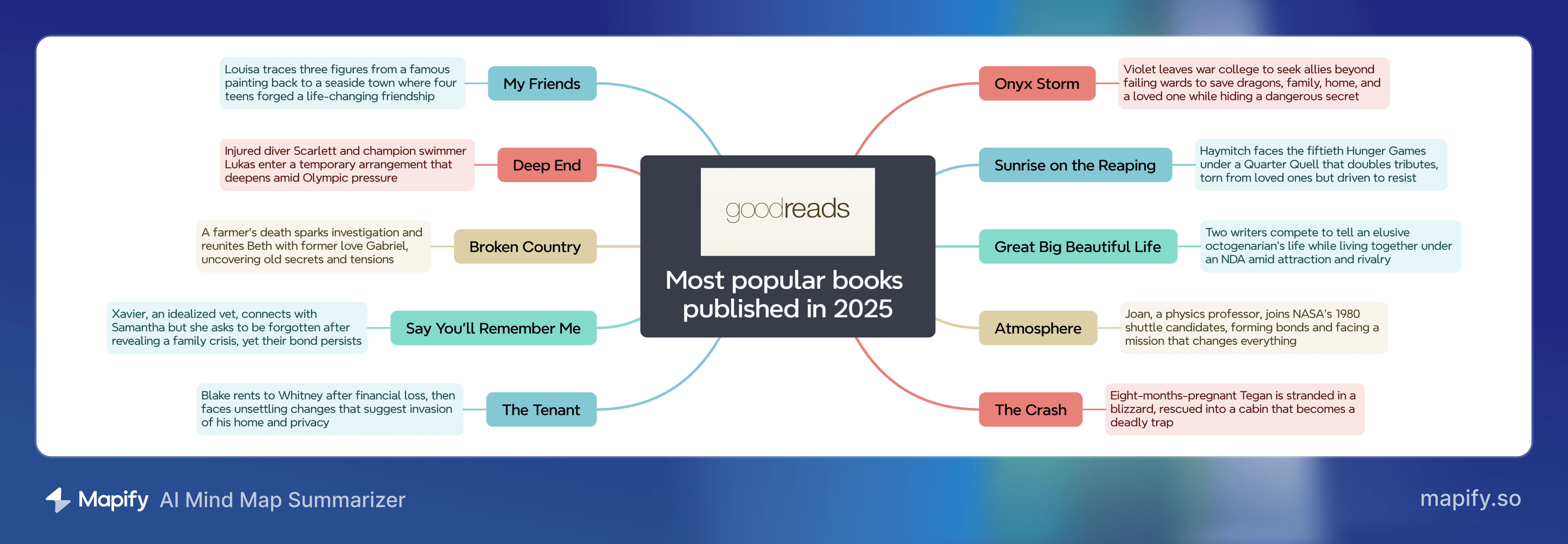
Share the most popular books published in 2025 mind map, made by Mapify.
This snapshot is based on Goodreads’ popular books published in 2025. It’s not a “best books” ranking, and it’s not meant to judge quality. It simply reflects where the reader's attention went.
A few things are immediately clear:
- Popularity comes from engagement, not critical consensus
- Series and familiar authors appear frequently
- Multiple genres compete for attention at the same time
Seeing the list as an overview makes it easier to understand the year as a whole, rather than as dozens of disconnected titles.
What “Popular” Really Means on Goodreads
On Goodreads, popularity is driven by reader activity. Books rise because people add them to shelves, read them, and talk about them. That makes these lists different from traditional bestseller charts or editorial selections.
Popular doesn’t mean universally loved. It often means:
- The book sparked curiosity
- It traveled quickly through reading communities
- It fits well into shared reading moments, like challenges or trends
This is why popular lists can feel messy or contradictory. They capture interest, not agreement.
What the 2025 Reading Year Reveals
Looking across the 2025 lists, several patterns stand out.
- Genre fiction—especially fantasy, romance, and thrillers—continued to attract large audiences
- Ongoing series and recognizable authors maintained strong momentum
- Readers moved fluidly between escapist reads and more reflective nonfiction
- Fewer books felt “central” to everyone; reading tastes were more personal and fragmented
This doesn’t suggest weaker books. It reflects how reading discovery has become more individual and community-driven at the same time.
Why Choosing What to Read Feels Harder
The challenge isn’t a lack of good books. It’s the volume of signals around them.
Recommendations now come from everywhere—platforms, social feeds, book clubs, and algorithms—and they don’t always agree. A book can feel unavoidable in one space and invisible in another. As a result, readers often collect titles faster than they can process them.
Lists help, but only up to a point.
Using Lists as Starting Points, Not Instructions
Goodreads lists work best when they’re treated as entry points rather than reading orders. Instead of asking which book ranks highest, it’s often more helpful to ask:
- What genres kept appearing this year?
- Which books actually stayed with me?
- What kind of reading experience was I looking for?
Understanding the structure behind a list can be more useful than memorizing the list itself.
Exploring Your Own Reading Year with Mapify
Instead of keeping your 2025 reading history as scattered titles or notes, you can use Mapify to summarize your year into a single visual overview. That might include:
- books you finished
- genres you returned to
- themes you cared about
- books you started but didn’t continue
Seeing your reading year laid out like this makes patterns easier to notice without forcing you to rank or judge anything.
Mapify book summarizer is also useful on a smaller scale. If certain books mattered more than others, you can summarize each ebook individually—capturing key ideas, themes, and takeaways—so those insights don’t disappear once you move on to the next read. Over time, this makes it easier to connect books with each other instead of remembering them in isolation.
Instantly turn your content into mind maps with AI
Get Started NowHow Mapify helps you with book summary
- Summarize books by uploading PDF files, chapter by chapter, and even chat with the PDF.
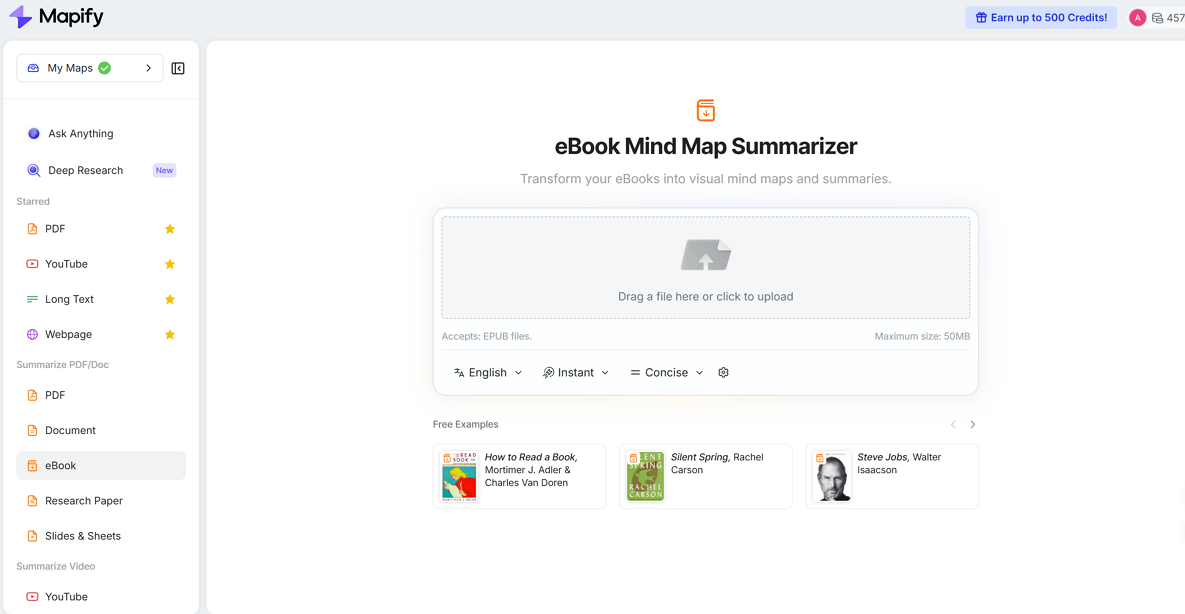
- Summarize eBooks directly, in the EPUB file format.
- Organize the web page content into mind maps.
- Chat with AI with any question or conduct deep research.
Looking Ahead to 2026
Many reading plans for 2026 start with long wish lists and recommendations. But they tend to work better when they’re grounded in reflection.
When you understand what kinds of books you actually engaged with in 2025—what held your attention and what quietly fell away—it becomes easier to choose more intentionally next year. Not more books, just better-aligned ones.
Platforms will keep suggesting new titles, and lists will keep growing. Having a clear view of your own reading patterns gives you something steadier to return to as you decide what to read next.
Instantly turn your content into mind maps with AI
Get Started Now

.png)